Introduction
Historical Background
The theory of sets was developed by the German mathematician Georg Cantor (1845–1918). While working on Problems on Trigonometric Series, Cantor encountered collections of real numbers that behaved in fascinating ways, leading him to formalize the concept of a set.
Today, Set Theory is recognized as the foundational system of modern mathematics. Almost all mathematical concepts are defined in terms of sets.
Need for Sets
In everyday life, we constantly group objects: a flock of birds, a team of players, a deck of cards. In mathematics, we need a rigorous way to group abstract objects — numbers, points, functions — to study their collective properties. Sets provide the grammar and vocabulary for the language of mathematics.
Everyday Examples vs. Mathematical Motivation
Everyday: The collection of books in a library; students in your class.
Mathematical: The collection of prime numbers; solutions to $x^2 - 5x + 6 = 0$; points on a circle.
Sets and Their Representations
Definition
A set is a well-defined collection of objects.
- The objects in a set are called its elements or members.
- Sets are usually denoted by uppercase letters ($A, B, C, X, Y, Z$) and elements by lowercase letters ($a, b, c, x, y, z$).
- If $a$ is an element of set $A$, we write $a \in A$ — read as "a belongs to A".
- If $b$ is not an element of $A$, we write $b \notin A$ — read as "b does not belong to A".
A collection is well-defined if, given any object, we can unambiguously determine whether it belongs or not.
✓ Set: Vowels in the English alphabet — everyone agrees it is exactly $\{a, e, i, o, u\}$.
✗ Not a set: Beautiful flowers — the term beautiful is subjective.
Standard Number Sets
Representations of Sets
There are two primary ways to represent a set:
Roster (Tabular) Form
List all elements inside braces $\{\}$, separated by commas.
Set-Builder Form
State the common property all elements possess.
Read as: "The set of all $x$ such that $x$ satisfies property $P$."
Rules for Roster Form
- Order does not matter: $\{1,2,3\} = \{3,1,2\}$.
- Repetition is ignored: The set of letters in APPLE is $\{A, P, L, E\}$.
Worked Examples
Ten sets described verbally, in roster form, and in set-builder form.
| # | Verbal Description | Roster Form | Set-Builder Form |
|---|---|---|---|
| 1 | Vowels in the English alphabet | $\{a,e,i,o,u\}$ | $\{x \mid x \text{ is a vowel in English}\}$ |
| 2 | Natural numbers less than 6 | $\{1,2,3,4,5\}$ | $\{x \mid x\in\mathbb{N},\ x<6\}$ |
| 3 | Solutions to $x^2=4$ | $\{-2,2\}$ | $\{x \mid x^2=4,\ x\in\mathbb{Z}\}$ |
| 4 | Prime numbers between 10 and 20 | $\{11,13,17,19\}$ | $\{p \mid p\text{ is prime},\ 10<p<20\}$ |
| 5 | Even natural numbers | $\{2,4,6,8,\dots\}$ | $\{x \mid x=2n,\ n\in\mathbb{N}\}$ |
| 6 | Odd natural numbers less than 10 | $\{1,3,5,7,9\}$ | $\{x \mid x=2n-1,\ n\in\mathbb{N},\ n\le 5\}$ |
| 7 | Factors of 12 | $\{1,2,3,4,6,12\}$ | $\{x \mid x \in \mathbb{N},\ 12 \text{ is divisible by } x\}$ |
| 8 | Multiples of 5 greater than 0 | $\{5,10,15,20,\dots\}$ | $\{x \mid x=5n,\ n\in\mathbb{N}\}$ |
| 9 | Letters of the word SCHOOL | $\{S,C,H,O,L\}$ | $\{x \mid x\text{ is a letter in SCHOOL}\}$ |
| 10 | Integers whose square is less than 10 | $\{-3,-2,-1,0,1,2,3\}$ | $\{x \mid x\in\mathbb{Z},\ x^2<10\}$ |
Interactive Activity
Use the GeoGebra applet below to practise writing sets in set-builder form.
If the applet does not load, open it on GeoGebra ↗
Beyond the Syllabus: Russell's Paradox †
Russell's Paradox (1901)
In 1901, mathematician Bertrand Russell discovered a fundamental flaw in early Set Theory, which allowed any collection to be a set. He proposed:
— the set of all sets that do not contain themselves.
Question: Does $R$ contain itself? Is $R \in R$?
- If $R \in R$, then by its defining rule it must not contain itself — so $R \notin R$. Contradiction.
- If $R \notin R$, then it satisfies the defining property of $R$ — so $R \in R$. Contradiction.
This paradox led to the development of rigorous axiomatic systems such as Zermelo–Fraenkel Set Theory.
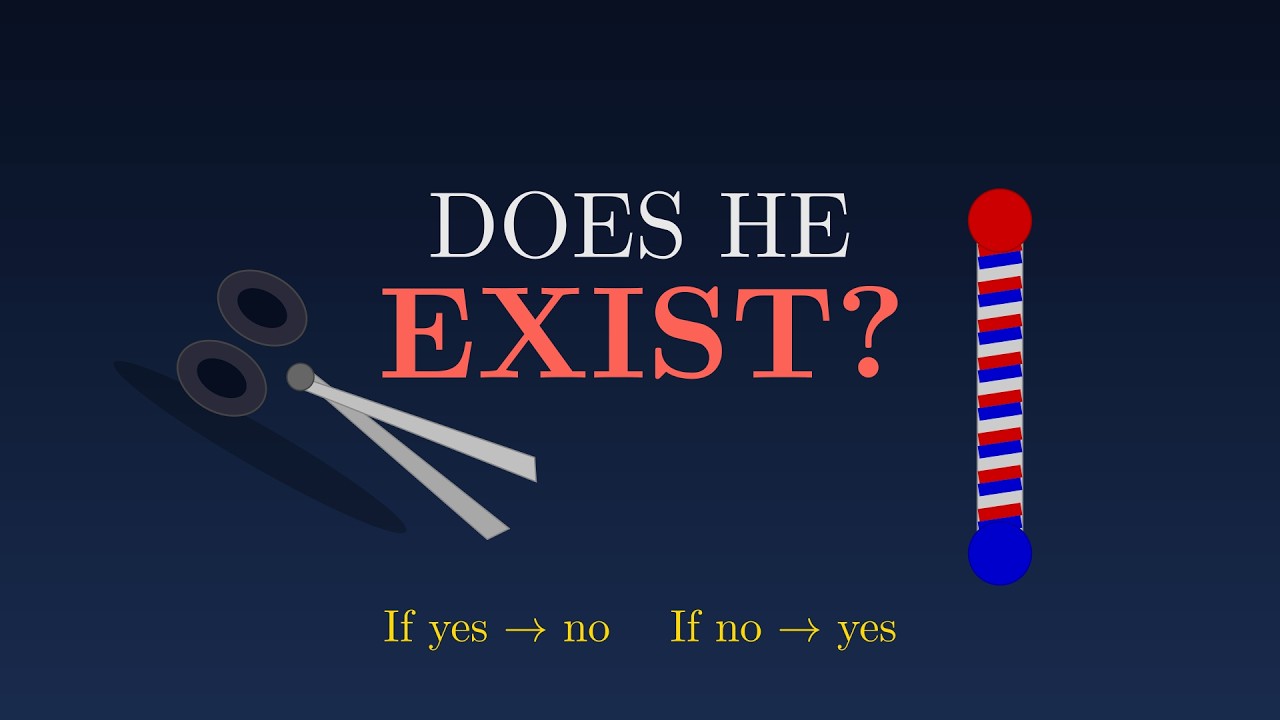
Watch: Russell's Paradox Explained
Check Your Understanding
Attempt the following before the next class.
Is the collection of all "clever students" in your class a set? Give a reason for your answer.
Write the set of all integers $x$ such that $-2 < x \leq 3$ in roster form.
Write the set $\{2, 4, 8, 16, 32\}$ in set-builder form.
Give an example of an infinite set in roster form.
Write the set $\{x \mid x \in \mathbb{Z},\ -3 \leq x \leq 3\}$ in roster form, and verify that $0$ is an element of this set.